
Check Your Ego at the Door

Welcome to the Why to Wow newsletter, which is all about the Power of Differentiation in our world of AI and commoditization. I thank our power readers who find our messages worthwhile. It’s inspiring to see that thousands are reading and recommending Why to Wow! I ask you to continue sharing this newsletter with friends, family, and associates to help change our world for the better.
“I’d rather fail on my own than ask for help to succeed.”
No one ever says that outright, but many people live it. Too many people struggle alone, convinced that asking for input makes them look weak. I’ve heard from executives across industries who say their team members only come to them when things are falling apart—by then, it’s usually too late to fix it.

The irony? The best leaders I know do the exact opposite. They actively seek input—from veterans, interns, and even competitors—because they know wisdom, like leadership, is title-free. High-performing teams in business and sports have these things in common: they listen, adapt, and collaborate.
I once had an associate tell me after losing a large project, “We need to make mistakes to learn.” Her sincerity struck me, but the logic didn’t. We don’t have to suffer from every mistake—if we’re willing to learn from others first. But if and when we do stumble, we’d better extract every bit of insight we can from it.
Back in the 1980s, a group of music legends gathered to record the song We Are the World for famine relief in Ethiopia. The producer, Quincy Jones, faced a room full of egos—household names, all accustomed to the spotlight. To reset the tone, he hung a simple sign on the studio door: “Check your ego at the door.” And they did. For one night, the biggest stars in the world sang in harmony for something bigger than themselves. The result raised millions and changed lives—not just because of their talent, but because of their humility.
Our businesses can be a little like that studio. They, too, represent worthy causes—places where we create jobs, solve problems, and serve others. Imagine what happens when we each check our egos at the door: we collaborate more freely, we innovate faster, and we elevate everyone around us.
Difference-Maker #1: Asking for help is strength, not weakness.
When I began my career, I was terrible at sales. I placed a phone call to Mike Huddlestun—a well-known local sales leader who didn’t know me at all—and asked if I could learn from him. Without hesitation he said, “Sure, how about lunch today?” I later questioned why he agreed so quickly. He said, “Because hardly anyone ever approaches me for help.” That lunch turned into a mentoring friendship that shaped my career. People want to share what they know, but you have to ask.
Difference-Maker #2: You’re not obligated to take advice.
Seeking guidance doesn't mean surrendering your judgment. Often the best decisions come after hearing multiple—sometimes opposing—perspectives. The goal isn’t to outsource your thinking, but to deepen it. Every viewpoint you gather sharpens your decision-making.
Difference-Maker #3: Wisdom has no rank or age.
Insight can come from a 28-year-old analyst or a 60-year-old executive. The simple act of listening tells others they matter—and it reminds you that learning never stops. When you show respect for another person’s insight, both of you leave the conversation smarter.
So before your next meeting, deal, or decision, take a breath…and check your ego at the door. You might be surprised by what you hear and learn—and how far it takes you.
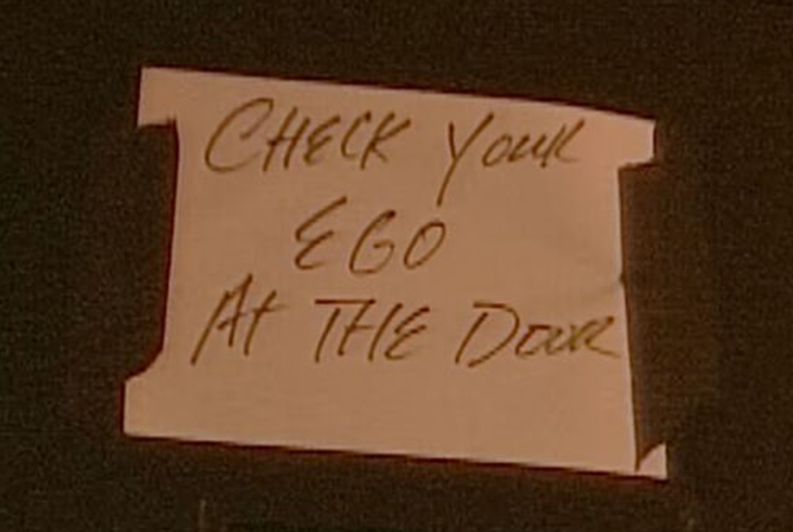
The original sign Quincy Jones posted on the studio door.
Please consider joining the growing number of followers and subscribers of our podcast, Difference Talks. Over 1,400 people have joined the family! Our goal is to inspire over one million people worldwide with our message.